
CSMU Hosts 2025 Sustainability and Smart Innovation Hackathon Finals
CSMU Hosts 2025 Sustainability and Smart Innovation Hackathon Finals
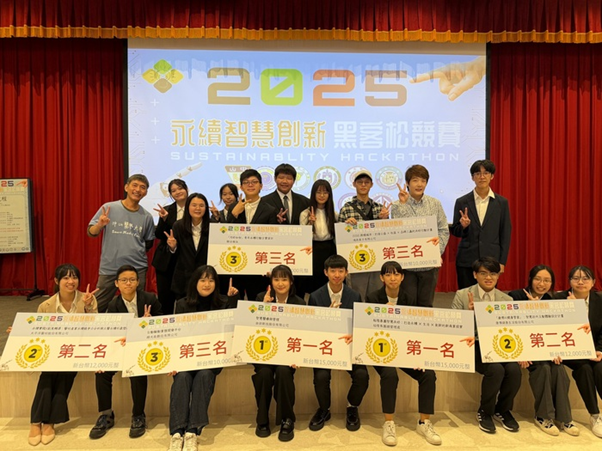
The 2025 Sustainability and Smart Innovation Hackathon, hosted by Chung Shan Medical University (CSMU), held its final competition on November 13 on campus. The event attracted participants from 11 universities across Taiwan, together with 21 companies and non-profit organizations, who collaborated to address 23 industry-proposed challenges and present their final project outcomes.
CSMU student teams demonstrated outstanding performance throughout the competition. A total of 17 teams advanced to the finals, working on 11 different industry challenges. Their achievements included two first-place awards, three second-place awards, five third-place awards, and seven merit awards, highlighting students’ strong capabilities in sustainability-oriented, smart, and interdisciplinary innovation.
Centered on the United Nations Sustainable Development Goals (SDGs), the competition adopted a practice-oriented model in which industry partners proposed real-world challenges and students developed feasible solutions. The competition focused on four major themes—sustainability, smart applications, innovation, and resilience. Challenge topics covered a wide range of areas, including smart healthcare and improvements in clinical services, the application of digital technologies in health management settings, as well as initiatives related to the circular economy, sustainable business models, and social impact.
According to the organizers, the preliminary stage attracted 417 teams nationwide. Following joint evaluations by industry representatives and academic experts, six teams per challenge were selected to advance to the finals. On the final competition day, 138 teams and 548 students participated through oral presentations and project demonstrations. Projects were assessed based on proposal completeness, technical feasibility, innovation, and potential social impact.
CSMU President Chien-Ning Huang noted that the diversity of industry challenges reflected the growing expectation for higher education institutions to respond to complex social and industrial needs. Beyond healthcare-related topics, many challenges also addressed social responsibility, business innovation, and sustainable development. He emphasized that allowing industry partners to define real-world challenges enables students to think and act within authentic professional contexts, thereby strengthening their integrative thinking and problem-solving skills.
Several CSMU teams stood out in challenges related to sustainable lifestyle innovation, smart healthcare and management, and digital inclusion strategies for individuals with special needs. Judges recognized these projects for their strong balance of creativity and practical feasibility. The university highlighted that students were able to integrate healthcare knowledge with technological applications and management perspectives, reflecting CSMU’s long-term commitment to interdisciplinary education and practice-oriented learning.
During the event, President Huang formally passed the hosting responsibility for the next edition of the hackathon to the representative of the next host university. He emphasized that the competition is not only a student contest, but also an important collaborative platform connecting universities, industry partners, and society. CSMU will continue to strengthen industry–academia collaboration and innovative learning models, with the goal of cultivating young talents who possess a strong sustainability mindset and the ability to translate ideas into concrete actions for the future development of society and industry.