
CSMU Hosts Ju-Chuan Medical Education Lecture Highlighting Global Trends in Medical Education
CSMU Hosts Ju-Chuan Medical Education Lecture Highlighting Global Trends in Medical Education
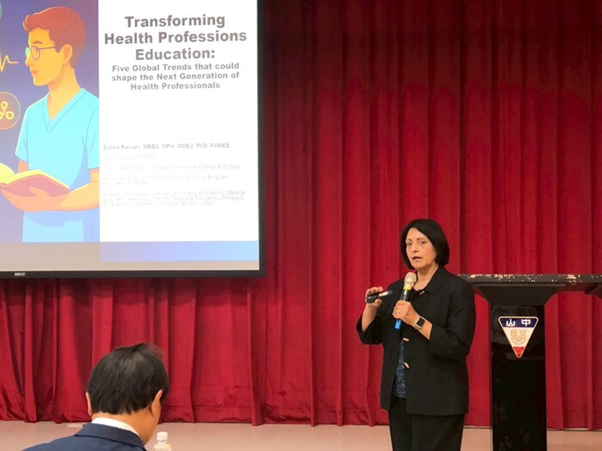
To celebrate the 65th anniversary of Chung Shan Medical University (CSMU), the university held its first Ju-Chuan Medical Education Lecture on November 4. The invited speaker was Professor Subha Ramani, a faculty member at Harvard Medical School and a senior leader in international medical education. She delivered a keynote lecture titled “Transforming Health Professions Education: Five Global Trends,” offering a global perspective on the future development of medical and health professions education.
During the lecture, Professor Ramani discussed five major trends shaping the education of future healthcare professionals. These include the growing role of artificial intelligence in clinical practice and education, competency-oriented approaches to medical training, the shift toward community-based care for aging populations and chronic diseases, the importance of interprofessional learning, and the well-being and professional identity of healthcare workers.
Professor Ramani noted that artificial intelligence is increasingly influencing healthcare and education, including areas such as medical imaging, patient monitoring, and simulation-based learning. These technologies can support learners by providing safe environments for clinical reasoning and practice. However, she emphasized that technology cannot replace the human relationship between healthcare professionals and patients. Medical education, therefore, must continue to emphasize ethical judgment, communication skills, and humanistic values alongside technological competence.
She further explained that the purpose of competency-oriented education is not simply to assess knowledge through examinations, but to ensure that learners are capable of delivering safe and effective patient care. Clear expectations, ongoing feedback, and consistent assessment practices are essential in supporting learner development. As healthcare increasingly extends beyond hospitals into community and long-term care settings, future professionals must also be prepared to collaborate across disciplines and understand social and community resources.
Professor Ramani also highlighted the importance of teamwork in healthcare, noting that shared language and clear roles within multidisciplinary teams should be established early in education. In addition, she stressed that the mental well-being and professional identity of healthcare workers are critical to the long-term sustainability of healthcare systems. Humanistic education, she stated, should be regarded as a core component of medical education rather than an optional addition.
Following the lecture, Professor Ramani met with CSMU leadership, faculty members, and clinicians from the affiliated hospital for further discussion. She shared principles of curriculum design, emphasizing that educational reform should begin by identifying real-world challenges, be tested through small-scale implementation, and expanded gradually based on outcomes. She also encouraged early exposure to clinical and community settings through observation, patient interaction, and supervised practice to strengthen empathy and communication skills.
Addressing challenges such as limited clinical teaching time and the increasing use of artificial intelligence, Professor Ramani noted that similar issues are faced worldwide. She suggested incorporating short, focused teaching moments into daily clinical work and using repeated observations with timely feedback to support learning. She also emphasized that educators should develop basic literacy in artificial intelligence to help students understand information sources, limitations, and potential bias, thereby strengthening critical thinking skills.
Faculty participants agreed that Professor Ramani’s visit provided valuable insights into global trends in medical education and offered practical strategies for educational reform. Her perspectives on early clinical exposure, interprofessional learning, efficient clinical teaching, and systematic feedback will serve as important references as CSMU continues to advance medical education in response to technological change and evolving healthcare needs.